A prophecy was given about a man that would be pious and true. A book written by Lucy Menzies explains that the man would be named Columba, a son to Eithne and Fedlimidh. He would be born of noble birth from Ireland (Menzies). Columba has one brother and three sisters but spent very little time with them as he was sent away at a young age to be fostered (Menzies). A priest was chosen to foster Columba, which could have been the catalyst, besides the prophecy, to help set Columba on his path to sainthood (Menzies). Columba was sent to a monastery school to learn about religion, philosophy, literature and science along with other young scholars (Menzies). It as soon after Columba was finished with his schooling and venturing off on his own that his first miracle was performed, which was saving a girl’s soul after she was killed in front of his eyes and damning the soul of the man that did the killing (Menzies). Columba finished his training at Clonard, where he met his followers who would be with him on his journey that would set the legacy of St. Columba.
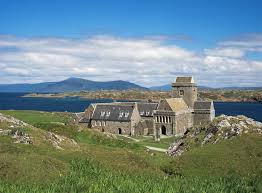
St. Columba traveled to Scotland in the 6th century to begin his mission to spread Christianity among those in Scotland and Northern England. St. Columba traveled to Isle of Iona and established his first church, according to the article St Columba and the Isle of Iona, written by Ben Johnson. St. Columba had twelve followers with on his journey to establish Christianity in a land that was once Pegan into faithful Christians (Johnson). St. Columba and his followers settled on the Isle of Iona to establish his first chapel, however none of the original building is still standing (Johnson). The story on how the chapel came about it rather strange. St. Columba comes from a long line of royalty and left his family of his own free will in hopes to make up for a disaster he had caused (Johnson). While he was building his chapel, he banished all women and cows, which meant the local parishioners had to leave their wives and daughters at Eilean nam Ban (Woman’s Island) (Johnson). St. Columba also banished frogs and snakes for some reason that is not clear. In order to complete the building of his chapel, St. Columba claimed he had to burry a live human being, in which one of his closest friends volunteered, who was later uncovered and found alive (Johnson).
Seems like a miracle that a man can be buried alive and live afterwards. St. Columba may not have created that miracle, but he did perform several others. There were several times St. Columbus was approached in hopes of making blessings and prophesize the future of rulers of great kingdoms, like when he did so during the battle of Miathi, according to and online text about the Life of St. Columbia. St. Columba was able to identify the sons that would not survive, Artur, Eochoid find, and Domingart, and the son that would live a long life as the next ruler after King Aiden, which was his son Eochoid Buide (Färber). Another prophecy in which the saint made was about two sons from two different fathers and how the son’s fates would end sooner than expected (Färber). St. Columba’s words were taken in truth often, but there were times when even the word of a saint was not taken with head. A young man would not take St. Columba’s advise and would sail out in a path that held a large beast (Färber). The young man survived, went back to St. Columba to inform him that he was indeed correct about the beast (Färber). Not only was St. Columba able to make prophecies, he was able to perform miracles in the name of the lord. St. Columba had seen a cloud approaching the village he was staying in and recognized that nothing good would come from the rain that was to come (Färber). He took himself and Silnan, one of his monks, with him to prepare for this unfortunate event (Färber). Once he made all the preparations, he made the final step, which was making holy water that would cure those that became ill from the effects of the rain (Färber). This helped to save many lives as well as many animals, which helped to save people from future starvation and poverty (Färber). Another miracle was when the saint saved the life of a young man named Columban (Färber). The grandson of Brian was negligent while doing his chores which gave the demon that was lurking in the corner time to invade the pail of milk the youth was to take inside (Färber). St. Columba as nearby and saw everything happen and was able to dispel the demon in a manner in which left the child unharmed, if only shook-up (Färber). These are only a few accounts of the prophecies and miracles the saint performed. A saint life is not measured in the amount of work he does. That being said, being able to perform one miracle is an amazing accomplishment. Take a journey, just like St. Columba and discover the beauty of the Isle of Iona.
Bibliography
Färber, Beatrix. “The Online Resource for Irish History, Literature and Politics.” CELT, 23 Oct. 2008, celt.ucc.ie/.
Johnson, Ben. “St Columba and the Isle of Iona.” Historic UK, www.historic-uk.com/HistoryUK/HistoryofScotland/St-Columba-the-Isle-of-Iona/.
Menzies, Lucy. St. Columba of Iona. Church of Scotland, 1935.
 Cassandra's Celtic Blog