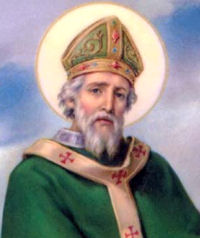
Once a year, for one day, a man by the name St. Patrick is celebrated across the world. He is man painted by the color green and is adorned with shamrocks. Beer is toasted in his name and people try to imitate the best Irish accent to be just like the revered St. Patrick. However, the history of the man who have been celebrated for years is something of a mystery.
One of the biggest revelations about St. Patrick is that Patrick may not even be his name. The only true recollection of St Patrick is from his writing of the Confessio. However, that has not stopped researchers from trying to figure out where St. Patrick’s roots are and hopefully to nail is heritage. There was man by the name of Palladius who is supposed to be the first Christian missionary in Ireland, according to “St. Patrick and The Irish” written by Ludwig Bieler. However, the first true mention of St. Patrick is when his captors, Miliuc, mention a “Cothraighe” in his retelling of his purchase of a family, which is presumably St. Patrick and his siblings according to On the Name… written by J. H. Todd. Miluic also refers to St. Patrick as “Cotrick.” (Todd, 295) Cothraighe is a Gaelic corruption of Patricius, which is Latin, which happens to be apart of St. Patrick’s full name. (Todd, 294) St. Patrick’s real name is “Magonus Sucatus Patricius.” This helps to support the translations of the names given to St. Patrick from his captures. Sucatus is a Welch name, giving St. Patrick a Celtic roots (Bieler, 292).
St. Patrick was born in about 385 AD and lived a rather uneventful life until he turned sixteen (Bieler, 292). At the age of sixteen, St. Patrick and his sisters were taken captive by Irish raiders and then sold as slaves further in Ireland. (Todd) Moncure D. Conway, who writes “The Saint Patrick Myth” explains that St. Patrick refers to Ireland as Hiberio in his book “Confessio,” where St. Patrick also explains his time as a captive. (Conway, 360). While in Ireland, St. Patrick as employed at a cattle attendant where he began to find his faith and he prayed day and night (Conway, 360). After six years of captivity he was able to flee for a boat over two hundred miles away to make his escape (Conway, 360). While on his voyage home, St. Patrick was able to prove to himself and those aboard the vessel His divine plan for St. Patrick for he was able to save those on the ship from starvation and death (Conway, 360).
Once he was back home, St. Patrick began his journey to spread his faith to those he believed needed it the most. It is interesting that, where Palladius failed, St. Patrick was able to succeed in his journey of riding the country of pagan and converting the people to Catholicism (Conway, 362). Throughout St Patrick’s journey, he must have realized how important the upper class is in setting trends, for he converted those among the ruling class first and common people soon followed. (Bieler, 299). In his Confessio, St. Patrick remarks on “the fact that even the monastic life appealed strongly to young men and women of royal blood.” (Bieler, 299) It seems that royalty felt the most in need of a true religion because it did not take a lot of convincing for St. Patrick to convert them. Although, St. Patrick has been referred to as the Irish Moses. (Conway, 365) So it might not have been that the royalty were easy to win over, it is that St. Patrick was truly a vessel of God and was possessed that extra quality that allowed people to trust him and really believe him. St. Patrick truly believed in what it took to be be a clergy member and knew what it took to lead people, so he provided ways to train the clergy (Bieler, 301).
Regarding the serpent, the one St. Patrick banished from Ireland, it was not confirmed what and when that was. It is a theory the serpents are a metaphor. The serpents symbolize all of the those who were pagans, but he was able to drive out that reptile just like he was able to eradicate the pagan lifestyle in so many people. St. Patrick came from a background of misfortune, but he did not let destroy him. He took the time given to him to find himself and find his calling. He found who was and now he is celebrated for his actions. St. Patrick gets one day a year, with people toasting in his honor and painting on green clovers, to be celebrated for his courageous actions in Ireland. Although knowing about who St. Patrick is interesting, it does not further explain why he is celebrated like he his. Attached is a podcast about why St. Patrick day is celebrated and more fun facts about him.

Bibliography
Bieler, Ludwig. “St. Patrick and the Irish People.” The Review of Politics, vol. 10, no. 03, Cambride university Press for the University of Notre Dame du lac on behalf of Review of Politics, 1948, p. 290.
Conway, Moncure D. “The Saint Patrick Myth.” The North American Review, Vol. 137, No. 32, University of Northern Iowa, Oct 1883. pp. 358-371
Todd. J. H. “On the Name Said to Have Been Given to St. Patrick When a Captive in Ireland.” Proceedings of the Royal Irish Academy (1836-1869), Vol. 6 (1853 – 1857), pp. 292- 298
 Cassandra's Celtic Blog